
As more students balance academic responsibilities with work and personal challenges, timely mental health support has become increasingly important. A questionnaire was administered to 500 current college students and recent graduates on behalf of the University of West Alabama (UWA) to explore how students experience access to mental healthcare and the barriers that continue to limit it.
Respondents included undergraduate and graduate learners from across the U.S. To complement these survey insights, researchers also analyzed Google search data spanning January 2024 through March 2026, examining student mental health search activity across all 50 states.
Building on these findings, this report details widespread mental healthcare needs, persistent gaps in availability and emerging perspectives on how the counseling workforce can evolve. These insights point to both challenges and opportunities for the future of student well-being.
Key Takeaways
- California leads the nation in student mental health searches, with 776 per 100,000 residents.
- 1 in 2 students who needed mental health support have skipped getting help because the wait was too long.
- 87% of students said they have felt they needed mental health support, and 1 in 10 could never access it.
- Work schedules or other responsibilities (48%) and cost (45%) are bigger barriers to student mental healthcare than wait times alone (32%).
The States Searching the Most for Mental Health Support
Search behavior for student mental health-related terms offers a window into where students are actively seeking help and where demand may be accelerating. These patterns help illustrate how mental health needs are distributed across states.
California reported the highest level of student mental health search activity, with 776.0 searches per 100,000 residents. Other states with elevated demand included Washington (678.6), Minnesota (649.5), Oregon (603.3) and Virginia (503.6). Here is the complete list of states with the highest demand for student mental health support:
Top 10 States With the Highest Demand for Student Mental Health Support
- California: 776.0
- Washington: 678.6
- Minnesota: 649.5
- Oregon: 603.3
- Virginia: 503.6
- Nebraska: 494.3
- Massachusetts: 488.5
- Illinois: 432.8
- Iowa: 430.9
- New Mexico: 430.9
In contrast, several states recorded lower search activity. Here are the states where students are least likely to seek mental health support:
States Where Students Are Least Likely to Search for Mental Health Support
- Montana: 261.3
- Indiana: 255.2
- Alabama: 253.9
- Oklahoma: 246.9
- Louisiana: 241.8
- Kentucky: 241.5
- Idaho: 236.7
- Mississippi: 223.8
- Arkansas: 219.4
- West Virginia: 215.2
These geographic differences suggest that, while demand is national in scope, the intensity of student mental health concerns and help-seeking behavior varies significantly across regions.
The Wall Between Students and Care
Many students recognize the importance of mental health support, yet accessing care remains a challenge. Structural barriers, scheduling conflicts and financial concerns often stand in the way of timely assistance. These obstacles can delay or prevent students from receiving the help they need.
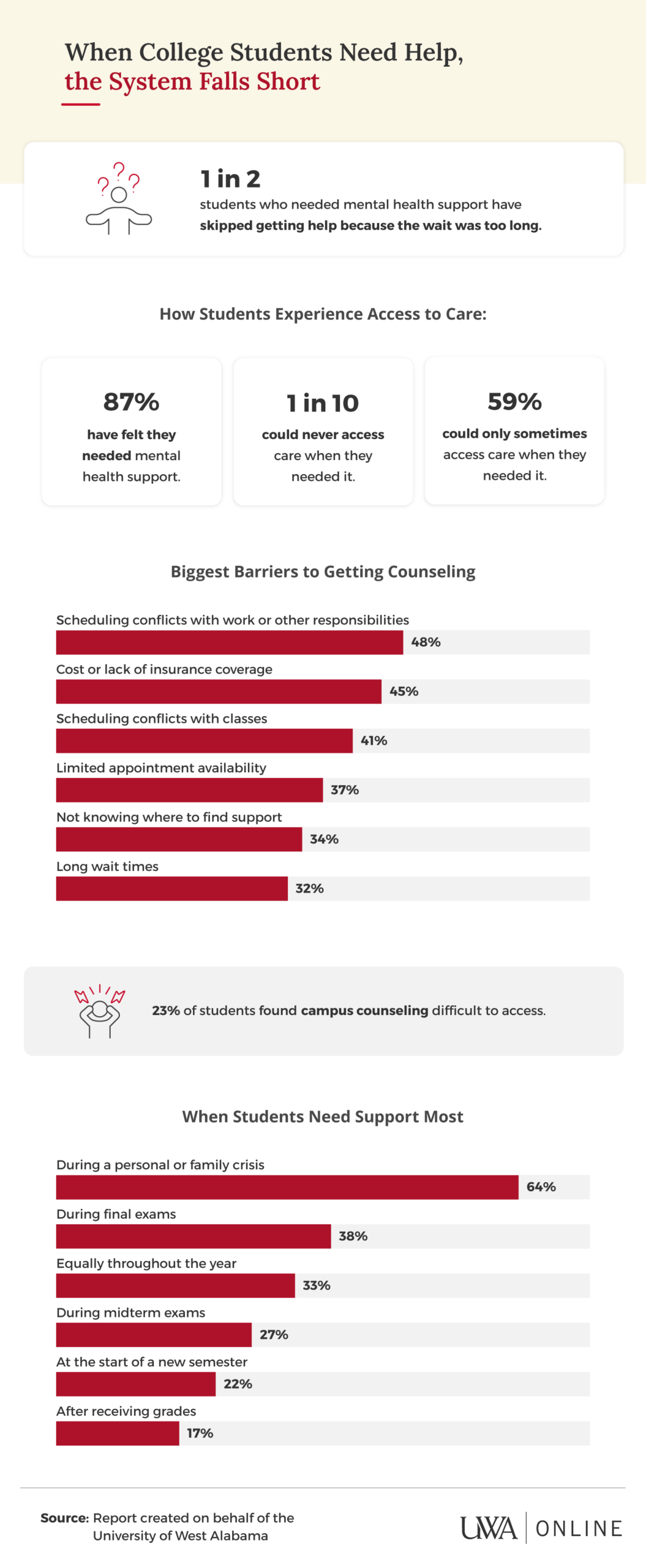
A large majority of students (87%) reported that they have felt a need for mental health support. However, 1 in 10 said they were never able to access care. Among those who sought help, wait times posed a major obstacle: 1 in 2 students who needed support skipped care because the wait was too long. Additionally, 29% of students who pursued campus counseling reported waiting three or more weeks for an appointment.
While delays remain a concern, other barriers played an even larger role in limiting access. Work schedules or other responsibilities affected 48% of students, and cost was a factor for 45%, both exceeding the 32% who cited wait times alone as a barrier. Competing responsibilities and financial pressures affect students’ ability to prioritize mental healthcare.
Preferences around appointment times further reflect these challenges. Weekday evenings after 5 p.m. were identified by 66% of students as the most accessible option, followed by Saturdays (50%) and Sundays (41%). Fewer students preferred weekday mornings before 9 a.m. (25%), indicating that flexibility outside traditional work hours may improve access.
Become Part of the Solution
Explore the ProgramTraining the Next Generation of Counselors
As demand for mental health services grows, attention has shifted to the counseling workforce’s capacity. Students are increasingly aware of provider shortages and are considering how education and training pathways can help. Expanding access to counselor training may be a key factor in meeting future needs.
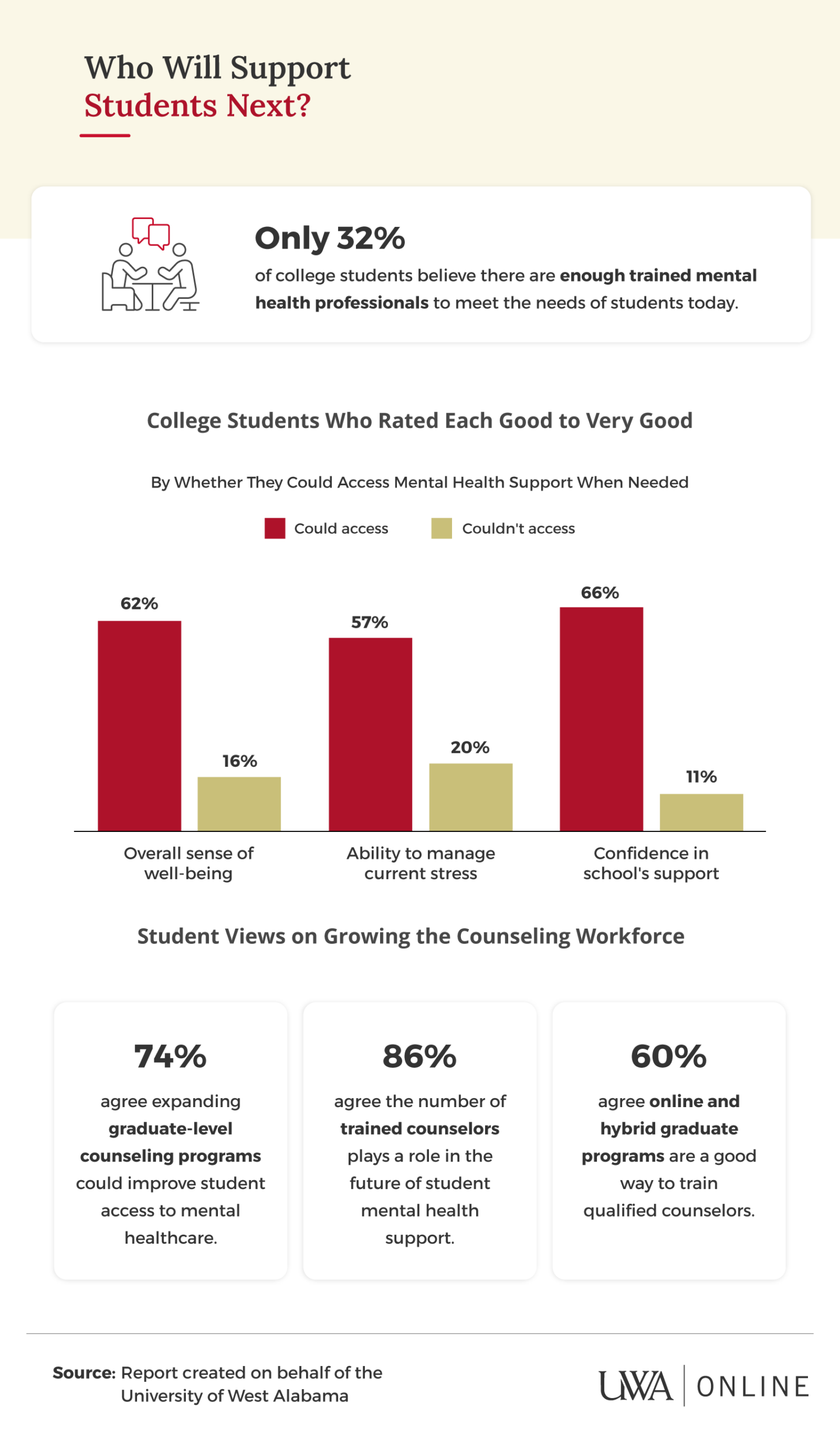
Just about one-third of college students (32%) believe there are enough mental health professionals to meet current student needs. Federal data backs up that concern. The Health Resources and Services Administration reports that more than 148 million people in the U.S. live in designated mental health professional shortage areas, with only about 27% of identified need currently being met. This perception aligns with broader concerns about access and availability, reinforcing the urgency of expanding the workforce.
Students also expressed strong support for alternative training pathways. A majority (60%) viewed online and hybrid graduate programs as a credible way to train more counselors. These flexible formats may help remove barriers for aspiring professionals, making it easier to enter the field while balancing other commitments.
Understanding Student Mental Health Access Today
Many students need mental health support, yet access remains uneven. Geographic trends show varying levels of need, while systemic barriers such as scheduling and cost limit students’ ability to seek care. At the same time, concerns about the counseling workforce point to the need to expand training opportunities.
Addressing these challenges will require coordinated efforts across institutions, providers and educational programs. By understanding where gaps exist, stakeholders can better support student well-being and strengthen the future of mental healthcare.
Methodology
A questionnaire conducted on behalf of UWA surveyed 500 current adult college students and recent graduates across the U.S., including full-time undergraduate students (61%), part-time undergraduate students (17%) and graduate students (22%). The study explored access to campus and local mental health counseling services, barriers to care, peak periods of need, student well-being and perceptions of the mental health counseling workforce and training pipeline. Respondents were distributed across genders (57% women, 40% men) and generations (Gen Z 69%, millennials 25%, Gen X 5%).
Search trend data was gathered from Google Trends supplementary keyword data covering January 2024 through March 2026 across all 50 U.S. states, reflecting monthly search volume for student mental health-related terms normalized per 100,000 residents. The survey was conducted online in April 2026. All percentages are rounded to the nearest whole number.
About the University of West Alabama
The University of West Alabama offers flexible online degree programs designed for working adults seeking to advance their education in high-demand fields. UWA’s online Master’s in Clinical Mental Health Counseling program is CACREP-accredited and equips students with the counseling techniques and theories needed to become a counselor and support clients across varied populations. The program is completed entirely online, with the exception of one residency requirement, and is designed to meet the core educational components required by most states for counseling licensure.
Fair Use Statement
This content is intended for noncommercial use only. Reproduction or distribution should include proper attribution and a link to the University of West Alabama.