

Across the U.S, healthcare systems are working to keep up with rising demand for care as the aging population grows and experienced healthcare providers retire. At the same time, concerns about nurse burnout, staffing levels and access to nursing education continue to shape the future of the nursing workforce. To better understand nursing shortages by state, an analysis was conducted on behalf of the University of West Alabama (UWA). Researchers analyzed workforce and education data to determine where the pipeline of new registered nurses is growing and where it is falling behind.
This research explored how nursing education, enrollment trends and workforce data intersect across the country. By analyzing graduation rates, nurse employment data from the U.S. Bureau of Labor Statistics (BLS) and institutional data on nursing schools, the findings reveal where states are producing enough new nurses to support their healthcare systems and where gaps could contribute to a future shortage of nurses.
Key Takeaways
- Utah ranks No. 1 for nursing graduates per capita (354.7 per 100,000 residents), followed by Minnesota at No. 2 (323.3), both producing more than three times the national average (96.1).
- Alaska ranks last in nursing pipeline coverage (3.4%), followed by Oregon (4.6%) and Hawaii (4.7%), each producing fewer than five new nursing graduates per 100 employed RNs.
- California ($140,330 median RN wage), Hawaii ($136,320) and Oregon ($123,990) rank among the highest-paying states for nurses, yet sit in the bottom 10 for pipeline coverage.
- 60% of the country has below-average access to online nursing education: 30 states fall below the national average of 0.66 online nursing schools per 100,000 residents.
Where America’s Nursing Workforce Is Growing and Where It’s Falling Short
The number of new nurses entering the profession is critical to maintaining a stable healthcare workforce. States that graduate more nurses relative to their existing number of nurses are better positioned to support hospitals, clinics and other healthcare services in the next decade.
States that produce fewer new nurses may face increasing pressure on their healthcare providers. As baby boomer nurses retire and healthcare demand grows, a weak pipeline of new nurses can lead to understaffed hospitals, rising patient ratios and increased nurse burnout.
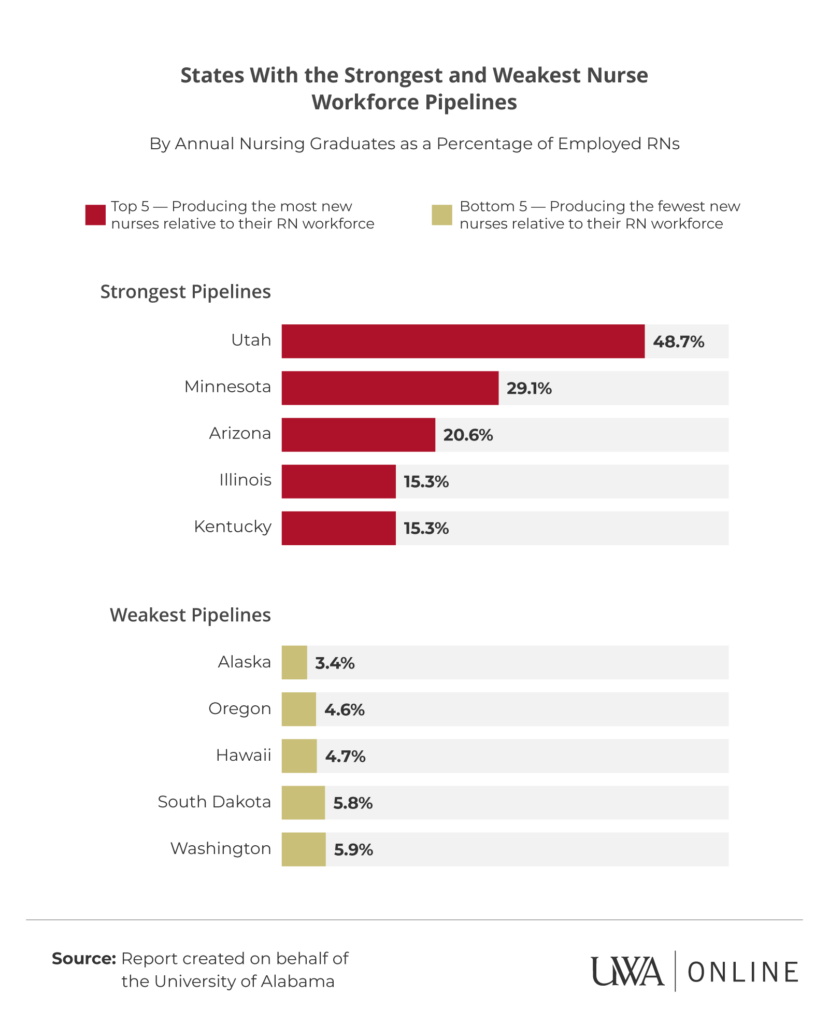
Utah leads the nation in nursing graduates per capita with 354.7 graduates per 100,000 residents. Minnesota ranks second with 323.3 graduates per 100,000 residents. Both states produced more than three times the national average of 96.1, highlighting strong nursing education pipelines supported by nursing schools and workforce development initiatives. These states also rank among the strongest in pipeline coverage, meaning they are training a significant number of new nurses compared with the size of their existing registered nurse workforce. Arizona, Illinois and Kentucky also appear in the top tier, helping strengthen the nursing workforce through higher graduation output.
Other states face a weaker supply of new nurses relative to their existing nurse employment levels. Alaska ranks last with just 3.4% pipeline coverage, followed by Oregon (4.6%) and Hawaii (4.7%). In these states, fewer than five new nurses graduate annually for every 100 employed registered nurses.
Complicating this issue, several of these states also offer some of the highest nursing wages in the country. According to BLS, California’s median registered nurse wage reached $140,330, followed by Hawaii ($136,320) and Oregon ($123,990). Despite strong pay incentives, these states remain among the lowest in nursing pipeline coverage. This suggests that salary alone does not resolve workforce shortages.
States Ranked by Strongest to Weakest Nurse Workforce Pipelines
1. Utah: 48.7%
2. Minnesota: 29.1%
3. Arizona: 20.6%
4. Illinois: 15.3%
5. Kentucky: 15.3%
6. Alabama: 12.9%
7. New Hampshire: 11.4%
8. Idaho: 11.2%
9. Arkansas: 10.5%
10. Virginia: 10.4%
11. Indiana: 9.85%
12. Mississippi: 9.85%
13. Oklahoma: 9.56%
14. Florida: 9.52%
15. Connecticut: 9.41%
16. North Dakota: 9.26%
17. Rhode Island: 9.07%
18. West Virginia: 9.07%
19. Ohio: 8.65%
20. Nevada: 8.65%
21. New Mexico: 8.6%
22. Tennessee: 8.59%
23. Texas: 8.59%
24. Wyoming: 8.47%
25. Wisconsin: 8.36%
26. Iowa: 8.19%
27. Montana: 7.99%
28. Maryland: 7.97%
29. Georgia: 7.84%
30. Nebraska: 7.73%
31. Missouri: 7.63%
32. New York: 7.58%
33. Maine: 7.54%
34. Louisiana: 7.38%
35. Pennsylvania: 7.29%
36. Kansas: 7.26%
37. North Carolina: 6.99%
38. South Carolina: 6.94%
39. Delaware: 6.91%
40. Massachusetts: 6.76%
41. Vermont: 6.62%
42. Michigan: 6.58%
43. New Jersey: 6.5%
44. Colorado: 6.38%
45. California: 6.33%
46. Washington: 5.87%
47. South Dakota: 5.84%
48. Hawaii: 4.74%
49. Oregon: 4.63%
50. Alaska: 3.38%
The Online Nursing Education Access Gap
Online nursing education allows working adults, licensed practical nurses and full-time healthcare employees to continue their nursing career while balancing professional and family responsibilities. States with strong access to online nursing schools may provide more opportunities for students to complete a BSN or other nursing programs. However, many areas still have limited availability of online programs, creating barriers for prospective nurses who cannot relocate or attend campus-based classes.
Rural states lead the country in per capita access to online nursing programs. North Dakota ranks first with 1.63 online nursing schools per 100,000 residents, followed by West Virginia at 1.42 and Wyoming at 1.36. These states provide residents with more opportunities to pursue nursing education remotely, which may support workforce growth in areas where healthcare providers are spread across large geographic regions.
Top 10 States — Most Online Nursing Program Access
1. North Dakota: 1.63
2. West Virginia: 1.42
3. Wyoming: 1.36
4. Kansas: 1.14
5. Maine: 1.13
6. South Dakota: 1.07
7. Arkansas: 1.06
8. Iowa: 1.05
9. Montana: 0.96
10. Kentucky: 0.87
Across the country, however, access remains uneven. The national average is 0.66 online nursing schools per 100,000 residents, yet 30 states fall below this benchmark. This means roughly 60% of the country has below-average access to online nursing education, potentially limiting enrollment and slowing the pipeline of new nurses entering the healthcare system.
Learn more about UWA's online RN-BSN program.
Learn MoreBottom 10 States — Least Online Nursing Program Access
50. California: 0.28
49. Florida: 0.30
48. Nevada: 0.30
47. Texas: 0.32
46. Arizona: 0.35
45. Utah: 0.37
44. Delaware: 0.38
43. Connecticut: 0.38
42. Oregon: 0.40
41. Washington: 0.40
Some states face a double burden: limited workforce pipelines and restricted educational access. California, Oregon and Washington rank in the bottom 10 for both pipeline coverage and online program access. This combination may make it more difficult to expand the nursing workforce in regions where healthcare demand continues to rise.
Large states with many nursing schools also show surprising gaps in online availability. California has 165 nursing schools, the most of any state, yet it ranks last in online program access per capita. Texas and Florida face a similar paradox: large numbers of institutions exist, but relatively few offer distance education options.
Even states with strong nurse graduation rates may still struggle with online access. Utah produces the highest share of new nurses nationally, with 48.7% pipeline coverage, but ranks 45th for online nursing program access. Expanding flexible learning opportunities could further strengthen nursing education pathways in these high-performing states.
What the Nursing Workforce Pipeline Means for Future Nurses
The distribution of nursing shortages by state highlights how education access, workforce demand and demographic trends shape the future of healthcare. States with strong pipelines of new nurses are better positioned to maintain stable nurse staffing levels and support growing patient needs.
For prospective nursing students, these patterns also highlight opportunities. Areas experiencing workforce shortages may see increased demand for nursing jobs, leadership roles, and advanced practice pathways such as nurse practitioners and other roles for Master of Science in Nursing (MSN) graduates.
As healthcare systems continue to adapt to population growth, public health needs and the long-term impact of the COVID-19 pandemic, the need for well-prepared registered nurses will remain critical. Nursing education programs that expand access and strengthen the pipeline of new nurses will play an essential role in supporting patient care nationwide.
Methodology
This study analyzed state-level nursing workforce and education data from three federal sources on behalf of the University of West Alabama.
- Nursing graduation data was sourced from the Integrated Postsecondary Education Data System (IPEDS) 2024 Completions survey, filtered to CIP code 51.38 (Registered Nursing, Nursing Administration, Nursing Research and Clinical Nursing), across all degree-granting institutions. State assignments were made using the IPEDS HD2024 Institutional Characteristics file.
- Registered nurse employment and wage data were sourced from the BLS Occupational Employment and Wage Statistics (OEWS), May 2024, SOC code 29-1141.
- Population estimates are from the U.S. Census Bureau 2024 state population estimates. Pipeline coverage is defined as the number of annual nursing graduates divided by the number of employed registered nurses, multiplied by 100.
- Online program access is defined as the number of nursing-producing institutions offering distance education programs per 100,000 residents, based on IPEDS IC2024 institutional characteristics.
The findings reflect a descriptive, data-driven analysis and are not intended to project future workforce conditions or represent clinical shortage designations.
About the University of West Alabama
The University of West Alabama offers an online RN to BSN degree that builds on your current nursing knowledge and prepares you for advanced opportunities in today’s evolving healthcare system. The program emphasizes evidence-based practice, leadership and community health while helping registered nurses strengthen the skills needed to deliver high-quality patient care.
Designed for full-time working nurses, the flexible online format allows students to complete coursework while maintaining their professional responsibilities. With guidance from experienced nursing faculty, students can complete the BSN degree in as little as one year while gaining the knowledge needed to expand their nursing career and contribute to the future of healthcare services.
Fair Use Statement
This content may be shared for noncommercial purposes only. If you reference or republish these findings, please provide proper attribution and a link back to The University of West Alabama.