
The choice between an ADN vs. BSN can shape your path in nursing. An Associate Degree in Nursing (ADN) and a Bachelor of Science in Nursing (BSN) both prepare students to take the NCLEX-RN exam and begin entry-level roles in health care. The right choice depends on your goals, timeline and career plans.
For registered nurses (RN) looking to grow professionally, the University of West Alabama’s online RN to BSN program offers a flexible and affordable way to advance their nursing education. In this article, you’ll learn how ADN and BSN programs compare in terms of program length, curriculum depth, clinical experience and long-term career potential. As you compare nursing degrees, understanding the benefits of each option can guide you toward a path that fits your goals, whether you are just beginning your nursing journey or building on the experience you already have.
| ADN vs. BSN: Program Comparison at a Glance | ||
| Category | ADN (Associate Degree in Nursing) | BSN (Bachelor of Science in Nursing) |
| Program length | ~2 years (Usually Community Colleges) | ~4 years (Universities) |
| Curriculum | Clinical basics | Includes leadership, research, public health |
| Clinical exposure | Core hospital rotations, such as acute care, pediatrics and mental health | Broader exposure, including quality improvement, policy, leadership and community |
| Skill emphasis | Technical, hands-on clinical prep Direct individualized bedside care Expedient workforce entry | Broader professional prep Leadership, research and systems thinking Long-term career growth and advancement |
Key Differences Between ADN and BSN Programs
Both ADN and BSN degrees prepare students for hands-on patient care. However, they differ in length, coursework and clinical exposure.
- Program length: ADN programs usually take about two years and are often offered at community colleges. BSN programs typically take four years to complete at universities.
- Curriculum depth: ADN programs cover the clinical basics, while BSN degrees include additional coursework in research, leadership, public health and communication.
- Clinical experience: BSN students often complete more diverse rotations, including time in leadership practicums and community health settings.
- Skill development: BSN-prepared nurses graduate with stronger leadership, communication and critical thinking skills.
If your priority is a faster route to licensure, an ADN degree program can be the more direct choice. If you are focused on broader roles and long-term growth, a BSN typically offers more opportunities. For those who already meet certain academic or licensure requirements, accelerated BSN programs and RN-BSN options can also shorten the path.
Career Opportunities and Advancement
After passing the NCLEX-RN exam, both ADN and BSN graduates are qualified to work as registered nurses. However, a BSN often opens doors to more career options in hospitals, clinics and community-based care.
Many health care organizations prefer or require BSN-prepared nurses for roles that involve leadership, coordination and quality improvement. According to the U.S. Bureau of Labor Statistics, registered nurses earn a median annual salary of $93,600, but those with a BSN tend to earn an average of $102,263 and move faster into supervisory or specialized roles. Financial aid and scholarships are often available to help reduce the cost of earning a BSN, making it a practical investment for long-term career advancement.
Is a BSN Worth It for Current RNs?
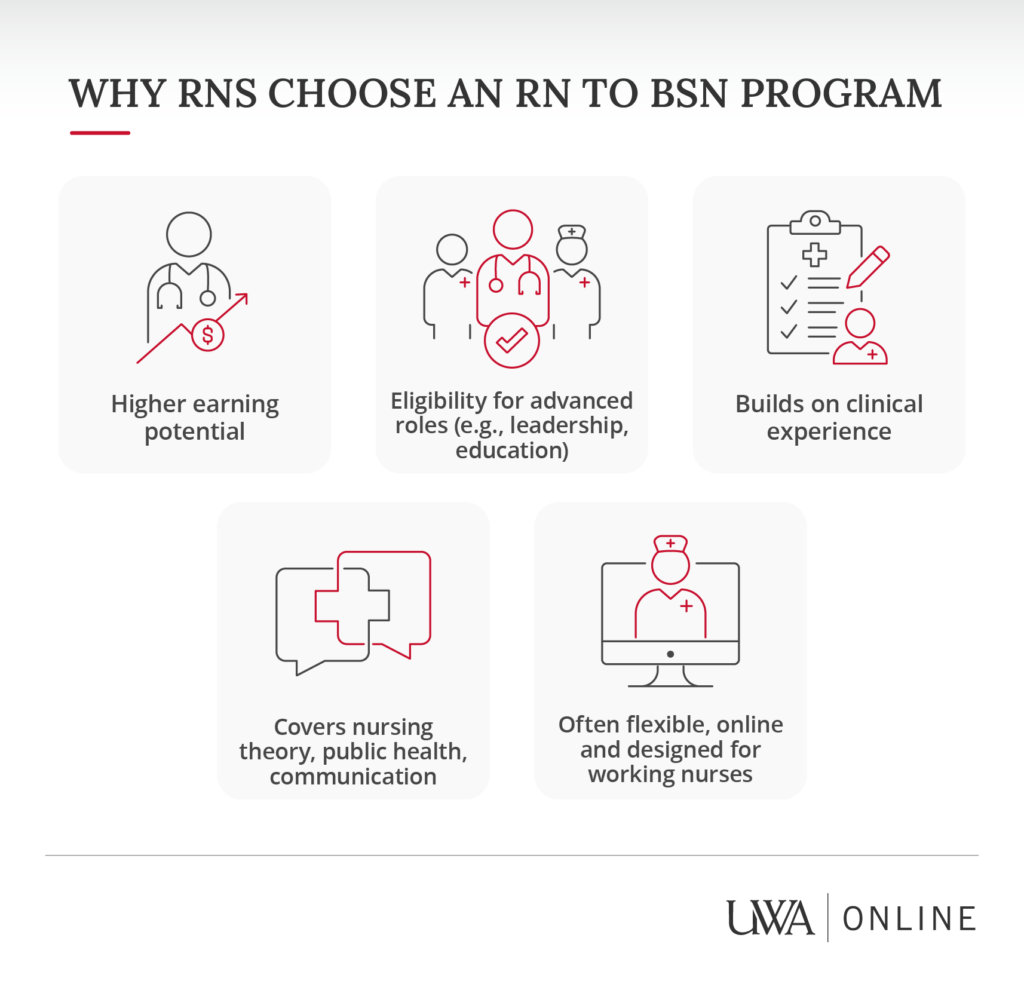
If you’re already working as an RN with an ADN, earning a BSN can pay off over the long term. BSN‑prepared nurses often see higher earning potential and become eligible for advanced roles beyond bedside care. BSN‑prepared nurses often report greater opportunities for leadership roles and higher salaries compared with ADN nurses.
Many ADN nurses choose an RN to BSN program to build on their clinical foundation while remaining employed. These programs help expand your nursing skill set — covering nursing theory, public health, leadership, evidence‑based practice and communication skills — making you a stronger candidate for management, education or research positions.
An online RN to BSN program designed for working nurses lets you balance work and study. With flexible scheduling and the ability to complete coursework online, you can continue working while pursuing career growth. Because a BSN program includes advanced coursework and often more varied clinical exposure, it can raise your readiness for leadership or specialty roles, giving you a wider variety of potential career paths.
Why Employers Value BSN-Prepared Nurses
BSN programs strengthen critical thinking, evidence‑based practice and patient care management. Nurses with a BSN are trained to apply current research and quality‑based care practices to improve patient outcomes.
BSN‑prepared nurses often take on supervisory or coordinating roles, working with interdisciplinary teams and sometimes overseeing less experienced staff such as LPNs. This makes them valuable in settings that require leadership, efficient care coordination and advanced competencies in nursing practice.
Hospitals increasingly value BSN education because studies link higher proportions of BSN‑educated nurses to better patient outcomes, including lower mortality, fewer complications and reduced failure‑to‑rescue rates. For many BSN graduates, the degree opens the door to graduate‑level nursing education (MSN or DNP), advanced practice roles and specialized career paths in leadership or clinical specialties.
How to Transition From ADN to BSN
If you plan to move from an ADN to a BSN, the process is more straightforward than many expect. Most RN to BSN programs follow similar steps, helping working nurses make the transition efficiently and affordably:
- Make sure you meet prerequisites, which are typically a valid RN license, official transcripts and sometimes a minimum GPA.
- Submit an application to your chosen RN to BSN program (many are online to accommodate working nurses).
- Get your ADN credits evaluated for transfer, so you don’t repeat coursework.
- Complete core BSN curriculum — coursework generally covers nursing theory, leadership, public health, pharmacology, evidence‑based practice and community health.
- Participate in any required clinical or practicum hours (sometimes these can be done in your existing workplace or through flexible scheduling).
- Receive academic support and advising, especially useful for balancing work and study.
- Graduate with a BSN to unlock access to leadership, specialty or graduate‑level training opportunities.
Learn more about UWA's online RN to BSN program.
Learn MoreMaking the Right Choice: ADN or BSN?
When deciding between an ADN degree and pursuing a BSN program, many factors come into play: time, cost, personal goals and where you want your career to go. ADN offers a faster route into entry-level nursing, which appeals if you want to begin working quickly. Because the ADN degree often costs less and takes roughly two years, it can be a practical choice for students eager to start earning as a registered nurse.
On the other hand, a BSN program provides more in‑depth education and stronger long‑term growth. BSN-prepared nurses tend to have higher earning potential, broader career opportunities and a stronger foundation for leadership or specialized roles in health care settings.
Ultimately, the right choice depends on your career goals, life circumstances and aspirations. If you want to start working soon and prioritize speed and affordability, ADN might make sense. But if you’re thinking long term and aiming for leadership, specialty units or advanced practice, BSN might offer better return on investment.
Take the next step from ADN to BSN with UWA’s flexible RN-BSN Online program.
Frequently Asked Questions

Choosing between an ADN and a BSN can raise a lot of questions, especially for those new to nursing or looking to advance. Below are some of the most common questions about these two nursing education paths.
What can a BSN do that an ADN can’t?
A BSN enables entry into advanced roles, including leadership, research, public health or specialty units such as community health, critical care or nursing education. BSN-prepared nurses often have broader competencies, making them eligible for supervisory responsibilities, advanced practice tracks or roles that involve coordination, policy or patient‑education duties.
What is the pay difference between ADN and BSN?
While exact salaries vary by role, location and experience, BSN-prepared nurses generally earn more than those with an ADN. The median annual salary for all registered nurses is $93,600, according to the BLS. However, nurses with a BSN report an average salary of $102,263. This suggests that ADN-prepared nurses typically earn less than the median — likely placing their average salary in the range of $84,000 to $88,000. That means BSN nurses may earn roughly $14,000 to $18,000 more per year on average, making a BSN a worthwhile investment for long-term earning potential.
Do hospitals prefer ADN or BSN nurses?
Many health care organizations favor BSN-prepared nurses because of the broader education in leadership, public health, research and critical care skills, which supports better patient outcomes and meets institutional standards for quality care. BSN education is frequently seen as a benchmark for nurses working in specialty units or leadership roles.
How long does it take to transition from ADN to BSN?
Most RN to BSN programs for working nurses can be completed in 12 to 18 months, depending on course load and transfer credits. The program from UWA can be completed in 12 months or less. This accelerated timeline makes a BSN an achievable goal even for those already working full-time as an RN.