

Teacher burnout continues to shape public discussion around education, yet many educators remain committed to the classroom. To better understand what motivates teachers to stay, a questionnaire conducted on behalf of the University of West Alabama (UWA) surveyed 365 current classroom teachers about burnout, career growth, compensation and long-term plans.
This research explored the factors influencing teacher retention and professional outlook. While burnout remains prevalent, the findings reveal strong peer support, meaningful student impact and clear opportunities for schools to strengthen long-term retention through compensation, recognition and professional development.
Key Takeaways
- 83% of teachers had a moment this past year that reminded them of why they became teachers, even as 68% reported being burnt out.
- 78% of teachers directly contributed to a student success story this past year, and 76% received encouragement from a colleague that kept them going.
- Half of all teachers remain optimistic about their future in education, and nearly half (47%) believe they will still be teaching five years from now.
- Teachers say they need $18,456 more per year to feel fairly compensated, and Gen Z educators face the largest gap at nearly $30,000.
- Nearly seven in 10 teachers (69%) currently work a second job, with more than four in five (82%) having worked one at some point in their careers.
Bright Spots in the Past School Year
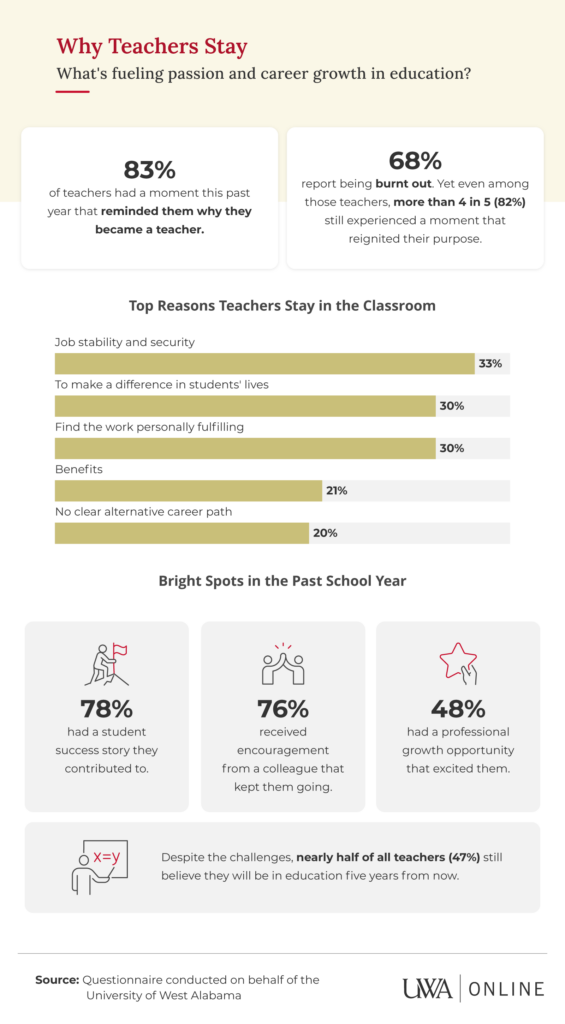
- 83% of teachers had a moment this past year that reminded them why they became teachers, including 82% of burnt-out teachers.
- Nearly seven in 10 teachers (68%) report being burnt out.
- 78% of teachers contributed to a student success story, and 76% received encouragement from a colleague that kept them going.
- Teachers who had a professional growth opportunity are more likely to be optimistic about their future in education (65%) than those who did not (36%). They are also more likely to plan to stay at least five more years (58% vs. 37%).
- Teachers who received recognition from their school or district are more likely to plan to stay for five more years (64%) than those who did not (37%). More recognized teachers feel optimistic than unrecognized teachers (67% vs. 39%).
- Teachers who feel supported by colleagues are more than twice as likely to be optimistic (58%) compared to those who do not feel supported (24%). Only 7% feel unsupported by fellow teachers.
- Even among teachers who have considered leaving, 44% remain optimistic about their future in education, and 40% who have taken concrete steps to leave still plan to be in education five years from now.
- Top reasons teachers stay include job stability and security (33%), wanting to make a difference in students’ lives (30%), personal fulfillment (30%), benefits (21%), and not having a clear alternative career path (20%).
- Burnt-out teachers are less likely to cite personal fulfillment (23%) compared to non-burnt-out teachers (45%), though both groups want to make a difference in students’ lives at similar rates (31% vs. 29%).
- 35% of teachers stay because they feel stuck due to limited alternatives or prior investment. Among that group, 82% report being burnt out.
Compensation Gaps and Structural Barriers to Long-Term Retention
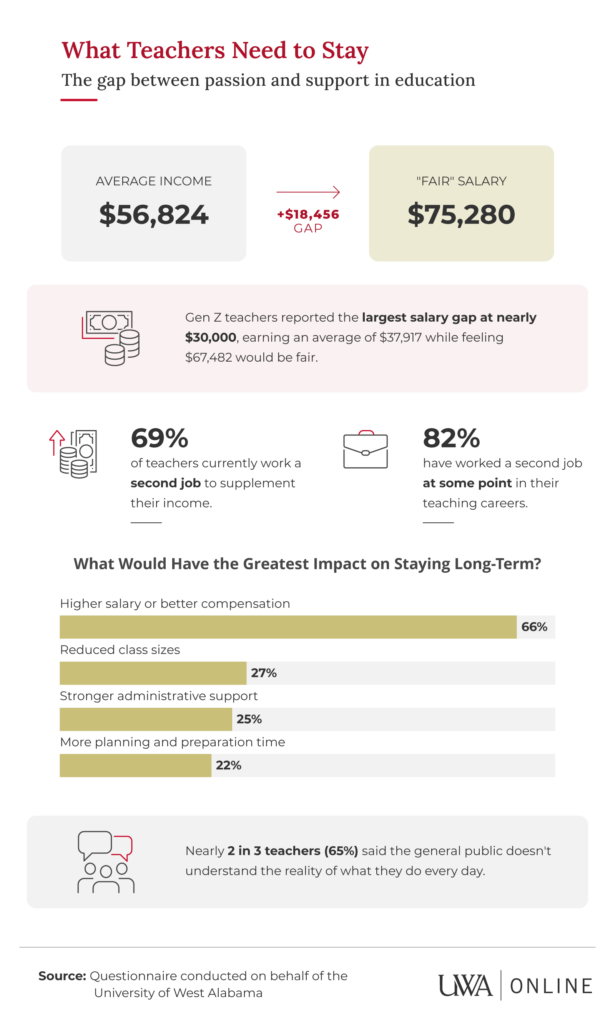
- Teachers report needing $18,456 more annually to feel fairly compensated.
- Gen Z teachers report the largest salary gap, with an average of $37,917, while feeling $67,482 would be fair. The gap narrows across millennials ($24,557), Gen X ($19,021) and baby boomers ($11,203).
- Pre-K and kindergarten teachers report the lowest average salary ($39,518) and the largest salary gap ($28,033), followed by elementary teachers ($25,691).
- Public school teachers report a $23,001 salary gap, nearly double that of private school teachers ($12,359).
- 69% of teachers currently work a second job, and 82% have worked one at some point in their career. More than four in five middle school teachers (82%) currently work a second job.
- Teachers who feel supported by school administration are more likely to plan to stay for at least five more years (58%) compared to those who do not feel supported (35%).
- Nearly half of teachers (48%) feel unsupported by state or federal education policies.
- Only about one-fifth of teachers (21%) agree that schools and districts are improving at retaining good teachers, while more than half (54%) disagree.
- 65% of teachers say the general public does not understand the reality of what they do every day.
- When asked what would have the greatest impact on staying long-term, teachers say higher salary or better compensation (66%), reduced class sizes (27%), stronger administrative support (25%), and more planning and preparation time (22%).
Ready to be part of the solution?
Learn MoreMethodology
A questionnaire was conducted on behalf of the University of West Alabama between February 19th and February 23rd, 2026, to understand what motivates teachers to remain in the profession despite widespread reports of burnout. A total of 365 current classroom teachers completed the survey.
Among respondents, 68% reported being burnt out, while 32% did not. By generation, 54% were millennials, 23% were Gen X, 18% were Gen Z and 5% were baby boomers. By gender, 62% identified as women, 36% as men and 2% as non-binary. By grade level, 25% primarily taught high school, 25% taught higher education, 22% taught elementary, 19% taught middle school, and 9% taught Pre-K or kindergarten. By school type, 65% taught at public schools, 19% at private schools, 7% at public charter schools, and 5% at parochial or religious schools.
The survey explored burnout levels, reasons for staying in or considering leaving the profession, supplemental employment, career growth perceptions, support systems, retention factors and long-term outlook. As with all self-reported questionnaires, responses reflected participants’ personal experiences and perceptions and may not represent the views of all teachers nationwide.
About the University of West Alabama
The University of West Alabama offers flexible online programs designed for working adults and aspiring educators. UWA’s online Bachelor of Science (BS) in Early Childhood/Elementary Education (P-3/K-6) program, which includes certification in early childhood education, prepares future teachers to support diverse learners across foundational grade levels. The BS degree blends coursework in child development, instructional strategies and classroom management with practical field experiences.
Fair Use Statement
The information in this article may be shared for noncommercial purposes only. Any reuse must include proper attribution and a link back to the University of West Alabama.