

As conversations about student mental health, academic recovery and school reform continue nationwide, educators are reconsidering how time is structured during the school day. From later start times to four-day school weeks, schedule flexibility has become a central topic in K-12 education. A questionnaire conducted on behalf of the University of West Alabama (UWA) surveyed 198 K-12 classroom teachers to better understand how they perceive school-day length, student fatigue and potential schedule changes.
This research explored how current schedules affect classrooms and what adjustments teachers believe could improve student well-being and learning. The findings revealed high levels of reported fatigue, interest in shortening the school day and strong support for a four-day workweek. At the same time, teachers identified tradeoffs, operational constraints and community barriers that complicate large-scale change.
- Teachers say the ideal school day is 6 hours and 30 minutes, about 30 minutes shorter than the current 7-hour average.
- 81% of teachers report student fatigue in their classrooms, citing sleep habits (76%) and screen time (49%) as the top causes.
- 80% of teachers support the four-day school week. They say family and childcare schedules are the top reason why it hasn’t happened.
- Nearly half of teachers (49%) want a shorter school day, and 81% of them want it cut by 30 minutes or more.
- 62% of teachers would cut Friday first if their school moved to a four-day workweek, while 20% would cut Monday.
Teachers Report Widespread Student Fatigue and Mixed Views on Day Length
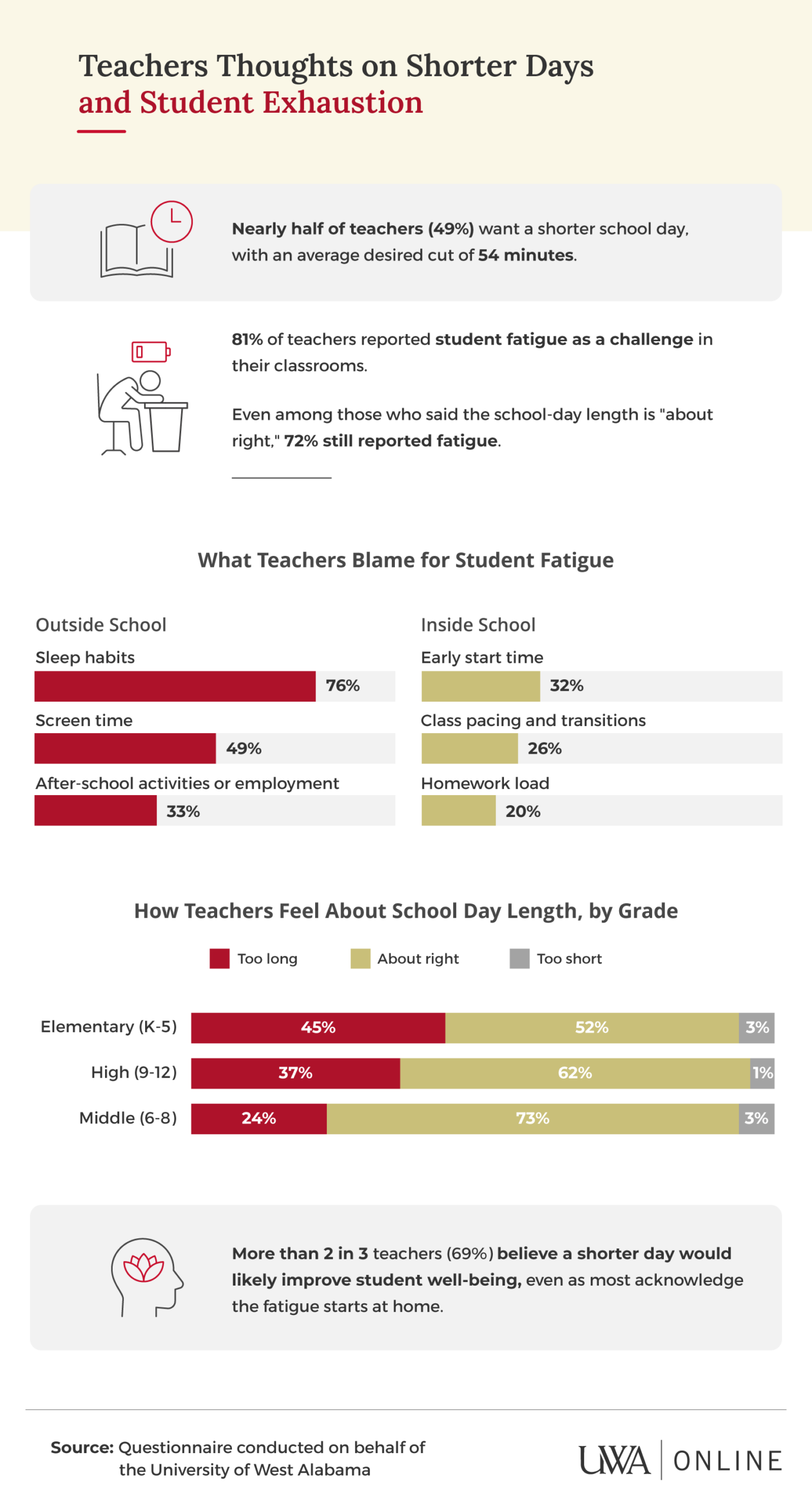
- Overall, 61% of teachers say the school day is about right, while 37% say it’s too long.
- Elementary teachers (45%) are more likely than high school (37%) and middle school (24%) teachers are to say the day is too long.
- Teachers say the ideal school day is 6 hours and 30 minutes, approximately 30 minutes shorter than the current 7-hour average.
- Elementary teachers show the highest interest in a shorter school day (56%), followed by high school teachers (49%) and middle school teachers (38%).
- Among teachers who prefer a shorter day, 81% want it reduced by 30 minutes or more. The most common desired cuts are 30 to 44 minutes and 1 hour to 1 hour 29 minutes, each selected by over one in four (27%).
- Teachers acknowledge tradeoffs: 72% say a shorter day would likely increase demand for after-school care, and 58% say it could reduce instructional coverage of standards.
- 38% of teachers report insufficient planning and collaboration time during the school day, regardless of overall schedule satisfaction.
- Nearly seven in 10 teachers (69%) believe a shorter day would likely improve student well-being.
Learn more about UWA's online Bachelor of Science in Early Childhood and Elementary Education program.
Learn MoreThe Fatigue Teachers See Among Students
- 81% of teachers report student fatigue as a challenge in their classrooms, and 44% describe it as significant.
- Reports of fatigue are highest among elementary teachers (84%), followed by high school (80%) and middle school (78%).
- Even among teachers who say the school day is about right, 72% report student fatigue.
- 89% of teachers who report student fatigue say it’s due to at least one out-of-school factor, most often sleep habits (76%), screen time (49%), and after-school activities or employment (33%).
- Teachers also point to in-school contributors, including early start time (32%), class pacing and transitions (26%) and homework load (20%).
Strong Support for a Four-Day School Week Despite Implementation Barriers
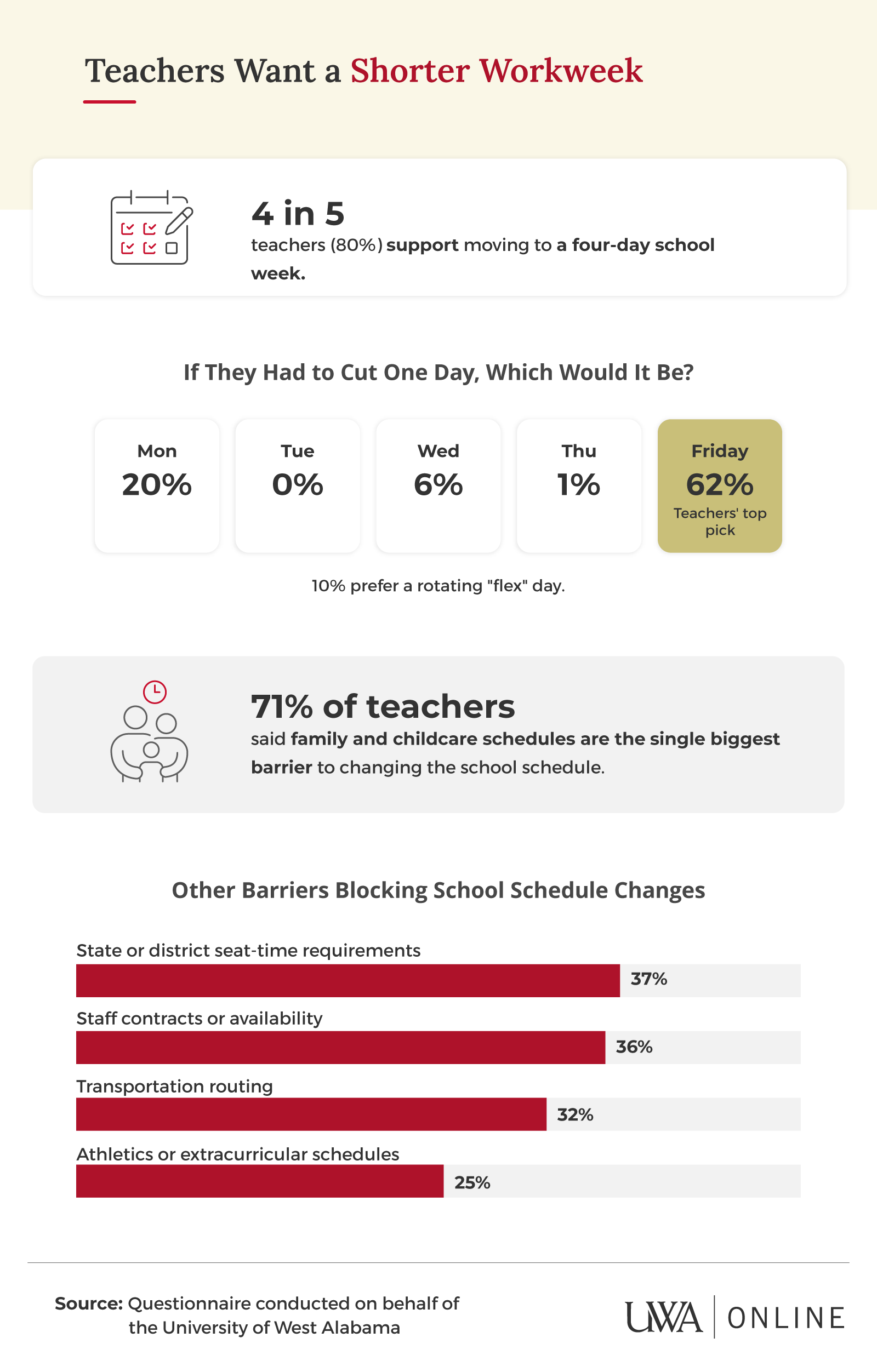
- 80% of teachers support moving to a four-day school week.
- 51% strongly support the four-day workweek, and 29% somewhat support it, while only 11% oppose it.
- Support is consistent across grades, with 82% of middle school teachers, 79% of elementary teachers and 79% of high school teachers in favor.
- The four-day week with a fifth optional day was the top preferred schedule model at 49%. Only 9% preferred the traditional schedule.
- 49% of teachers say a four-day week would have the greatest positive impact on teaching and learning.
- If required to cut one day, 62% teachers say Friday would be best, compared to 20% who say Monday. Friday is the top choice across grade levels, including 67% of high school teachers, 59% of elementary teachers and 56% of middle school teachers.
- Teachers identify family and childcare schedules as the single biggest barrier to changing school schedules at 71%.
- Additional barriers included state or district seat-time requirements (37%), staff contracts or availability (36%), transportation routing (32%) and athletics or extracurricular schedules (25%).
- 72% of teachers who support the four-day week also identify family and childcare as the top barrier.
- 79% of teachers say making the school day longer would likely increase student fatigue, and 65% say it would likely increase staffing or transportation costs.
- Beyond schedule length, teachers believe the top changes that would improve learning are more planning and collaboration time (41%), fewer non-instructional duties (37%) and better staffing (36%).
Methodology
A questionnaire was conducted on behalf of the University of West Alabama between February 13 and February 23, 2026, to understand how K-12 educators perceive school-day length, student fatigue and schedule reform. A total of 198 K-12 classroom teachers completed the survey after screening and quality checks. Among respondents, 41% teach elementary school (K-5), 36% teach high school (9-12) and 23% teach middle school (6-8).
The survey explored educators’ views on whether the school day is too long, too short or about right; the factors contributing to student fatigue; support for a four-day school week; preferred schedule models; and the operational barriers to implementing schedule changes. As with all self-reported surveys, responses reflected participants’ personal experiences and perceptions and may not represent the views of all K-12 educators nationwide.
About the University of West Alabama
The University of West Alabama offers flexible online programs designed for working adults and aspiring educators. UWA’s online Bachelor of Science in Early Childhood and Elementary Education program, which includes certification in early childhood education, prepares future teachers to support diverse learners across foundational grade levels. The program blends coursework in child development, instructional strategies and classroom management with practical field experiences.
Fair Use Statement
The information in this article may be shared for noncommercial purposes only. Any reuse must include proper attribution and a link back to the University of West Alabama.