

The challenges facing K-12 teachers have intensified in recent years. Growing workloads, evolving classroom expectations and increased emotional demands are reshaping what it means to be an educator. As schools continue to navigate staffing shortages and new technology, many teachers are beginning to question whether the role is sustainable long term. To better understand these shifts, a questionnaire was conducted on behalf of the University of West Alabama (UWA) among 207 K-12 classroom teachers across grade levels, experience levels and generations.
This research examined what is driving educators out of the profession and what could encourage them to stay. The findings highlight key pressure points, including burnout, leadership support, AI preparedness and expanding non-teaching responsibilities. They also point to something else. Many educators are not stepping away from education entirely but instead rethinking what their role in it could look like.
Key Takeaways
- 52% of American K-12 teachers would not encourage a young person they care about to become a teacher, rising to 67% among baby boomers.
- K-12 teachers with unsupportive school administration are nearly twice as likely to be planning to leave (53%) as those with supportive leadership (28%).
- Teachers who feel poorly prepared for AI in the classroom report moderate-to-severe burnout at 72%, compared to 43% among those who feel well-prepared.
- Handling student mental health crises is the fastest-growing non-teaching burden for K-12 educators, cited by nearly half of K-12 teachers (47%).
- Only 24% of K-12 teachers describe their school’s AI preparation as adequate.
The Expanding Role of Teachers Is Driving Burnout
The role of a teacher has expanded well beyond instruction, with many educators taking on additional responsibilities that contribute to stress and burnout. These growing demands are affecting how teachers view the profession and their future within it.
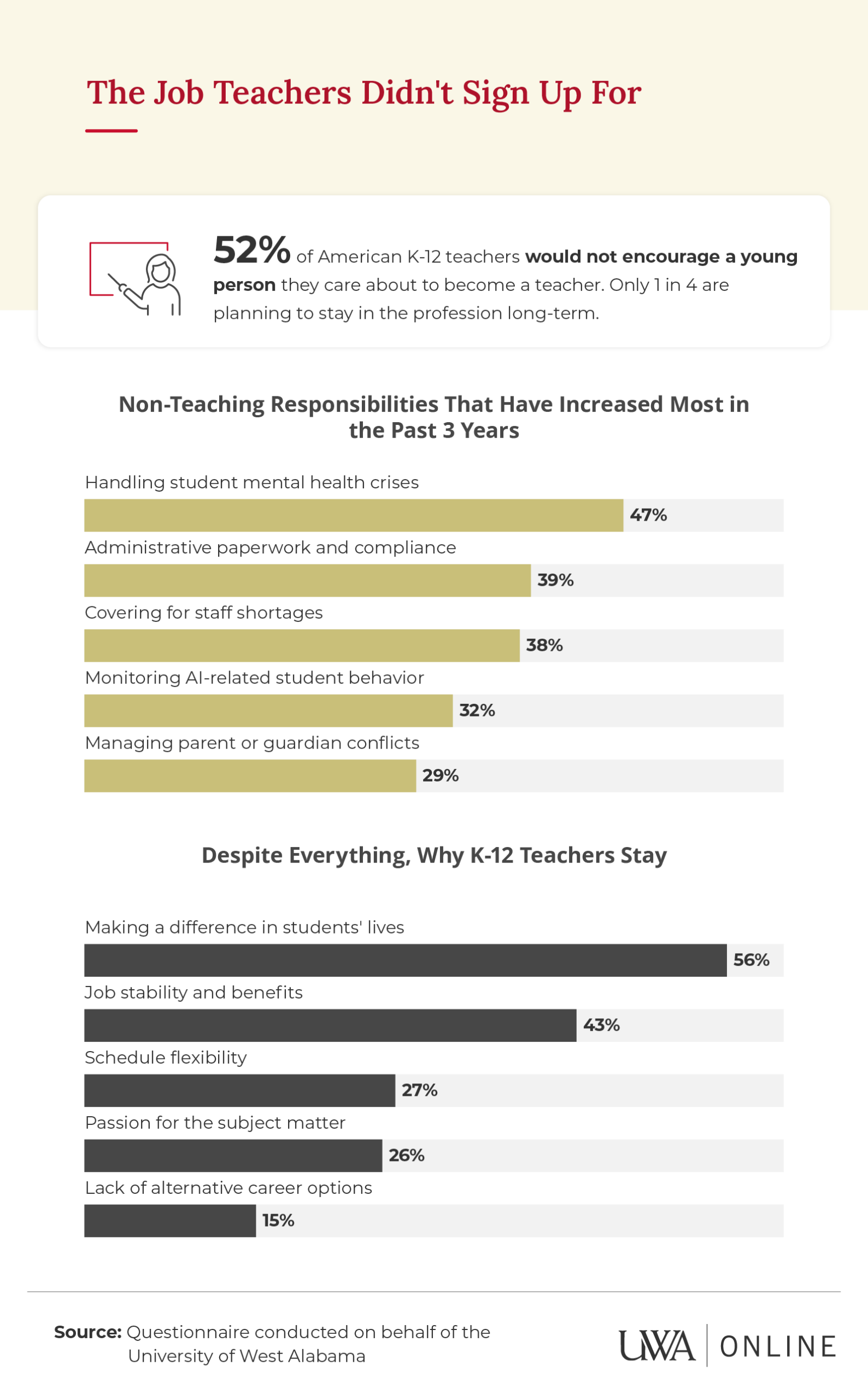
More than half of American K-12 teachers (52%) said they would not encourage a young person they care about to become a teacher, with that sentiment rising to 67% among baby boomers and 60% among Gen X teachers. This reflects a broader concern about the sustainability of the profession, as only a small share of educators (25%) are planning to remain long-term.
Non-teaching responsibilities now take up a significant portion of the workday. Seven in 10 teachers reported spending more than a quarter of their time on tasks unrelated to instruction. The most common increases included:
- Handling student mental health crises (47%)
- Administrative paperwork and compliance (39%)
- Covering for staff shortages (38%)
- Monitoring AI-related student behavior (32%)
- Managing parent or guardian conflicts (29%)
Burnout has become nearly universal across the profession. Most teachers (97%) reported at least some level of burnout, with 61% experiencing moderate-to-severe burnout. Many (71%) also said the emotional weight of the job is heavier now than in their first year, and 33% described it as significantly heavier.
These pressures vary across grade levels and career stages:
- High school teachers reported the highest rate of high or severe burnout at 36%, followed by elementary teachers (27%), pre-K or kindergarten teachers (22%), and middle school teachers (13%).
- Burnout was highest among Gen Z teachers (35%), followed by millennials (29%) and Gen X (27%), while no baby boomer teachers reported high or severe burnout.
- Mid-career educators were the most likely to consider leaving, with rates rising from 27% in the first five years to 33% among those with 11-20 years of experience.
Despite these challenges, many teachers remain motivated by their impact. More than half (56%) said making a difference in students’ lives was their top reason for staying. Other key reasons included:
- Job stability and benefits (43%)
- Schedule flexibility (27%)
- Passion for the subject matter (26%)
- Lack of alternative career options (15%)
What Teachers Say Needs to Change
While the challenges are significant, the findings show that targeted changes could improve retention. Teachers identified several factors beyond salary that would make the profession more sustainable and appealing.
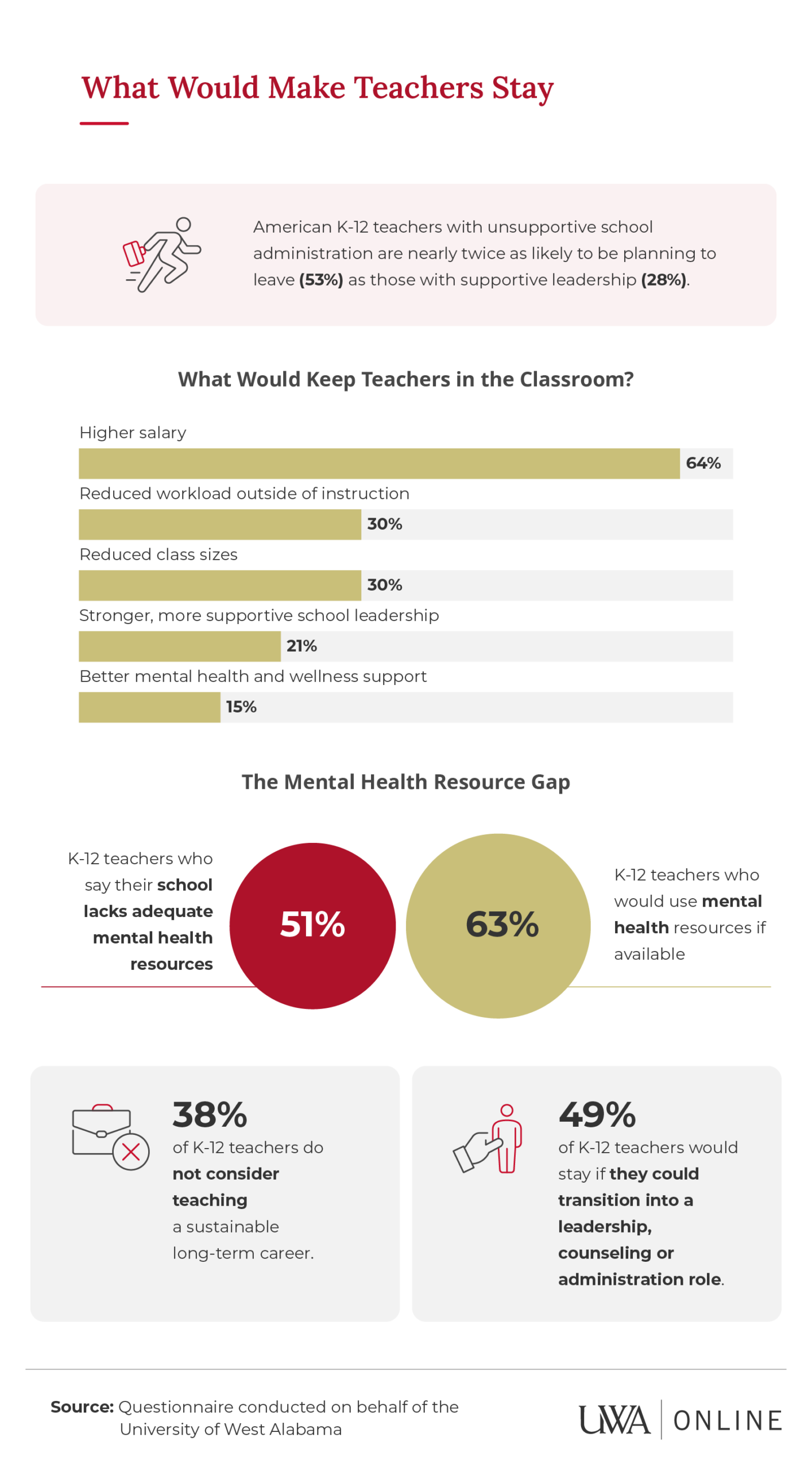
School leadership emerged as a critical factor. K-12 teachers who described their administration as unsupportive were nearly twice as likely to plan to leave, at 53% compared to 28% among those with supportive leadership. Most teachers said their administrators were supportive, but 27% said they were unsupportive.
Compensation remains important, but it is not the only driver. After a higher salary (64%), teachers identified these changes that would most influence their decision to stay:
- Reduced workload outside instruction (30%)
- Smaller class sizes (30%)
- Stronger, more supportive school leadership (21%)
- Better mental health and wellness support (15%)
Among those already considering leaving, the top three retention factors were:
- Higher salary (59%)
- Reduced workload (33%)
- Stronger leadership (30%)
More than one in three K-12 teachers (36%) said their school does not provide adequate mental health resources and that they would use them if available. Additionally, 38% of teachers who were uncertain about their future or considering leaving said they would stay if they could transition into roles such as leadership, counseling or administration.
Learn more about UWA's online Master of Education (MEd) in Learning, Design and Technology program.
Learn MoreThe AI Effect on K-12 Teachers
AI readiness has emerged as another major factor influencing burnout and workload. Only 24% of teachers described their school’s AI preparation as adequate. Those who felt unprepared reported significantly higher burnout, with 72% experiencing moderate-to-severe levels compared to 43% among those who felt prepared.
The impact of AI was especially strong in secondary education, where 54% of high school and 53% of middle school teachers said it increased their workload, compared to 17% of elementary and 15% of Pre-K or kindergarten teachers.
Even among those considering leaving, many still want to remain connected to education. Higher education or corporate training was the most common next step at 22%, suggesting that many educators are seeking more sustainable roles than classroom instruction, rather than leaving the field entirely.
What Comes Next for Teachers
The data shows just how much the role of a teacher has changed. Growing workloads, limited support and new expectations are making it harder for many educators to see a long-term future in the classroom. For some, that may signal it is time to take a different direction, but that does not mean leaving education behind.
Many teachers are finding new ways to use their experience in roles that still focus on learning and impact. Some move into instructional design, leadership, higher education or corporate training. These paths offer a chance to stay connected to education while working in environments that can feel more sustainable and flexible.
There is also room for improvement within schools. Strong leadership, better support and more manageable workloads can make a real difference for teachers who want to stay. The challenges are clear, but so are the opportunities to build a better experience for educators.
If you are thinking about what comes next, this moment can be a turning point. The skills you have built in the classroom still matter. They translate into many different roles where you can continue to grow and make an impact in education, just in a different way.
Methodology
A questionnaire was conducted on behalf of the University of West Alabama from April 1-2, 2026, to understand what is driving K-12 educators out of the profession and what would make them stay. A total of 207 K-12 classroom teachers completed the survey after screening and quality checks. Among respondents, 37% teach elementary (1-5), 33% teach high school (9-12), 14% teach middle school (6-8), and 13% teach Pre-K or kindergarten. The sample spans four generations, including millennials (48%), Gen X (30%), Gen Z (14%) and baby boomers (6%).
The survey explored educators’ levels of burnout, the expansion of non-teaching responsibilities that increase their workload, the impact of AI on their jobs, their long-term career outlook, which changes would have the greatest impact on their decision to stay, and the role of school leadership and mental health resources in teacher retention. As with all self-reported surveys, responses reflected participants’ personal experiences and perceptions and may not represent the views of all K-12 educators nationwide.
About the University of West Alabama
The University of West Alabama offers flexible online programs designed to support educators at every stage of their careers. For those looking to expand their impact beyond the traditional classroom, UWA’s online Master of Education (MEd) in Learning, Design and Technology program focuses on instructional design, digital learning and emerging education technologies.
The MEd online degree prepares educators for roles in areas like corporate training, instructional design and education technology, paths many teachers are increasingly exploring as they seek more sustainable and flexible careers. With an emphasis on practical application, UWA’s online programs are built to help working professionals adapt to the evolving demands of education.
Fair Use Statement
The information in this article may be shared for noncommercial purposes only. Any reuse must include proper attribution and a link back to the University of West Alabama.