

Teacher pay has become a growing concern across the U.S. as inflation and other factors continue to affect everyday living costs. While many states report pay gains for educators, those higher salaries do not always translate into stronger purchasing power.
For public school teachers comparing educator pay across different states, the key question is whether average teacher salary growth has kept pace with the rising cost of living. To explore this issue, an analysis was conducted on behalf of the University of West Alabama (UWA) to examine teacher salary by state using national datasets that track changes in teacher compensation.
This research explored how shifts in teacher pay affect the broader education system and the professionals working within it. Using data from the National Education Association (NEA)and federal inflation measures, the study examined how school teacher salary growth compares with rising living costs. There exist major disparities in educator pay. Only a handful of states have delivered real salary increases, while many others have experienced declines in purchasing power.
Key Takeaways
- New Mexico (+8.7%), Utah (+4.9%), Idaho (+2.8%), Colorado (+2.0%), California (+1.8%) and Arizona (+0.3%) are the only states where teacher salary growth has outpaced inflation since 2021.
- Teachers in New York are effectively earning nearly $10,000 less in buying power than they did in 2021.
- When adjusted for cumulative inflation, teachers in 44 of 50 states are earning less in real terms than they were in 2021.
- Teachers in Hawaii would need more than $8,000 in additional pay just to break even with inflation.
Ranking All 50 States by Real Wage Growth: Where Teacher Pay Is Actually Growing After Inflation
Changes in teacher compensation are often reported as salary increases, yet the real measure of progress depends on whether those increases exceed inflation. Evaluating teacher salary by state through an inflation-adjusted lens reveals which states are meaningfully improving educator pay and which are not.
When each state’s average teacher salary growth from 2020-2024 was compared with inflation since the 2020-2021 school year, only six states delivered real gains in teacher compensation. New Mexico led the nation with a real wage growth rate of +8.7%, followed by:
- Utah (+4.9%)
- Idaho (+2.8%)
- Colorado (+2.0%)
- California (+1.8%)
- Arizona (+0.3%)
These states represented the only places where salary increases allowed teachers to gain purchasing power over the past several school years. In dollar terms, New Mexico teachers experienced the largest improvement, gaining $4,755 in real earnings after adjusting for inflation.
Utah followed with a gain of $2,805, while California teachers saw a $1,531 increase in purchasing power. Idaho (+$1,432), Colorado (+$1,182) and Arizona (+$187) also recorded positive growth in real educator pay.
Where Teacher Pay Is Not Keeping up With Inflation
Across the rest of the country, the picture looks very different. With inflation taken into account, teachers in 44 states experienced declines in real earnings. These losses highlight the growing gap between nominal salary increases and the real value of teacher compensation. The largest decline occurred in New York, where teachers effectively lost $9,942 in purchasing power.
Massachusetts followed with an $8,929 loss, while Hawaii teachers would need $8,015 more in pay to keep up with inflation. The following round out the 25 states with the largest real salary declines:
- New Jersey (-$7,192)
- Pennsylvania (-$6,279)
- Wyoming (-$6,175)
- Alaska (-$6,060)
- Connecticut (-$5,953)
- Illinois (-$5,947)
- Rhode Island (-$5,896)
- Iowa (-$5,818)
- Michigan (-$5,447)
- Nebraska (-$5,232)
- Louisiana (-$5,002)
- Ohio (-$4,910)
- North Dakota (-$4,910)
- Minnesota (-$4,750)
- Missouri (-$4,650)
- New Hampshire (-$4,546)
- Kentucky (-$4,451)
- Texas (-$4,374)
- Delaware (-$4,347)
- Florida (-$4,272)
- Montana (-$4,054)
- Kansas (-$4,027)
Which States Are Accelerating Teacher Pay?
Even though many states saw declines in real earnings, the pace of teacher salary increases has recently begun to shift. Looking at acceleration trends provides insight into whether states are beginning to respond to educator pay pressures and teacher shortages.
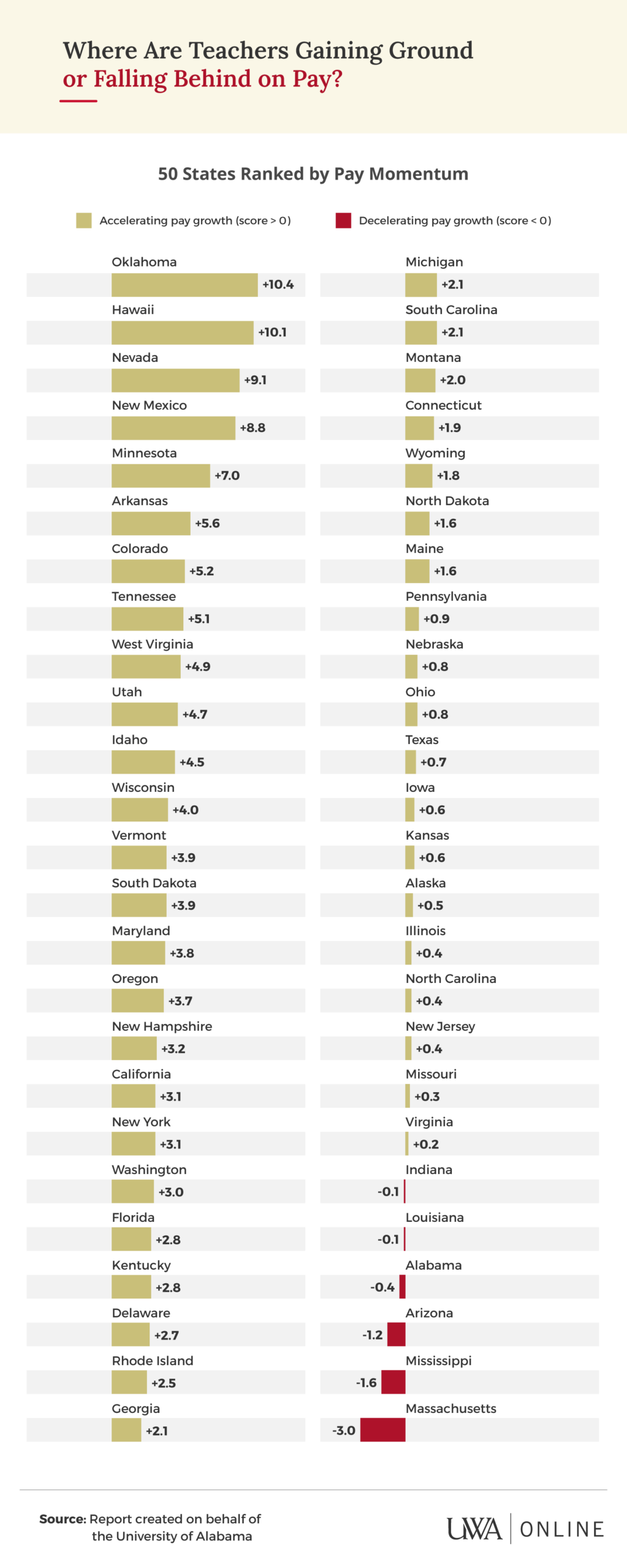
Despite years of purchasing power losses, 44 of 50 states have accelerated their rate of teacher pay growth between the early period (2020-2022) and the recent period (2022-2024) covered in this analysis. This shift suggests that many school districts and state governments have begun increasing pay more aggressively.
Oklahoma demonstrated the strongest momentum in the country. Teacher salary growth in the state rose from nearly flat levels in the early period (+0.1%) to a nation-leading +10.5% in the recent period, representing an acceleration of +10.4 percentage points. This sharp shift shows how some states are rapidly adjusting teacher compensation policies to improve recruitment and retention.
Top 20 States With the Fastest Accelerating Teacher Pay
- Oklahoma (+10.4)
- Hawaii (+10.1)
- Nevada (+9.1)
- New Mexico (+8.8)
- Minnesota (+7.0)
- Arkansas (+5.6)
- Colorado (+5.2)
- Tennessee (+5.1)
- West Virginia (+4.9)
- Utah (+4.7)
- Idaho (+4.5)
- Wisconsin (+4.0)
- Vermont (+3.9)
- South Dakota (+3.9)
- Maryland (+3.8)
- Oregon (+3.7)
- New Hampshire (+3.2)
- California (+3.1)
- New York (+3.1)
- Washington (+3.0)
Not every state followed that pattern. Indiana (-0.1), Louisiana (-0.1), Alabama (-0.4), Arizona (-1.2), Mississippi (-1.6) and Massachusetts (-3) posted negative acceleration scores. This means the pace of teacher pay growth in these states slowed in the most recent period compared with earlier years.
Learn more about UWA's online Education Specialist (EdS) in Elementary Education (K-6) program.
Learn MoreWhat the Real Teacher Raise Means for Future Educators
Teacher salary trends across the U.S. reveal a complex picture for the teaching profession. While a few states have achieved real gains in educator pay, most public school teachers have experienced declining purchasing power as salary increases struggle to keep pace with inflation and rising living costs. These disparities highlight the importance of continued investment in teacher compensation and policies that support recruitment and retention across school districts.
For individuals considering a career in education or seeking advancement through graduate study, understanding these trends provides valuable context on the realities of teacher pay across states. As school systems respond to staffing challenges and evolving economic pressures, well-prepared educators with advanced knowledge and leadership skills will play an essential role in strengthening classrooms and supporting the future of the education system.
Methodology
This study analyzed state-level public school teacher salary data on behalf of the University of West Alabama. Average teacher salary data for the 2020-2021, 2021-2022, 2022-2023 and 2023-2024 school years were sourced from the NEA Rankings of the States and Estimates of School Statistics reports. All rankings reflect only the 50 U.S. states.
Inflation adjustment was calculated using the U.S. Bureau of Labor Statistics (BLS) Consumer Price Index for All Urban Consumers (CPI-U), U.S. city average, annual average. The base year is 2021 (CPI-U: 270.970), and the comparison year is 2024 (CPI-U: 314.175), yielding a cumulative inflation rate of approximately 16.0% over the study period. Real wage growth was calculated as the percentage change in nominal salary from 2020-2021 to 2023-2024, minus the cumulative inflation rate. Real dollar gain or loss was calculated as the difference between the 2023-2024 nominal salary and the inflation-adjusted equivalent of the 2020-2021 salary.
The acceleration score is defined as the percentage change in average teacher salary from 2022-2023 to 2023-2024 (the recent period) minus the percentage change from 2020-2021 to 2021-2022 (the early period). Positive scores indicate that the rate of salary growth has increased; negative scores indicate that it has slowed or reversed. The findings reflect a descriptive, data-driven analysis and are not intended to project future workforce conditions or serve as official wage determinations.
About the University of West Alabama
The University of West Alabama offers flexible online bachelor’s degrees and master’s degrees designed for working adults who want to advance their careers. One option is the online Education Specialist (EdS) in Elementary Education (K-6) program, which helps teachers expand their knowledge of curriculum design, assessment, leadership and educational research. The fully online format allows educators to strengthen their expertise while continuing to work full-time.
Fair Use Statement
This content may be shared or referenced for noncommercial purposes only. When citing or using this information, please provide proper attribution and include a link back to the University of West Alabama.