

Hybrid learning combines in-person instruction with structured online learning, allowing students to divide their time between classroom and virtual settings. As more schools teaching K-12 adopt blended schedules, parents and teachers are forming stronger opinions about what works and what needs improvement. These evolving models are also influencing how schools allocate resources, train educators and measure student success.
A questionnaire was administered to K-12 parents and classroom teachers on behalf of the University of West Alabama (UWA) to capture attitudes toward hybrid learning in 2026. The research focuses on academic performance, student engagement, mental health, equity, and educator support across grade levels and instructional settings. For current and prospective education degree students, these findings offer insight into the realities of modern classroom environments and the skills schools increasingly expect from teachers.
Key Takeaways
- Parents with children in hybrid learning report lower burnout (34% have low stress levels vs. 28% among non-hybrid parents).
- 26% of parents with children in hybrid learning said their child’s academic performance has improved.
- 33% of parents rate hybrid learning better than traditional school, and 43% would stay in their district even if hybrid learning became permanent.
- Nearly half of parents (46%) support hybrid learning, compared to 39% of teachers with hybrid teaching experience.
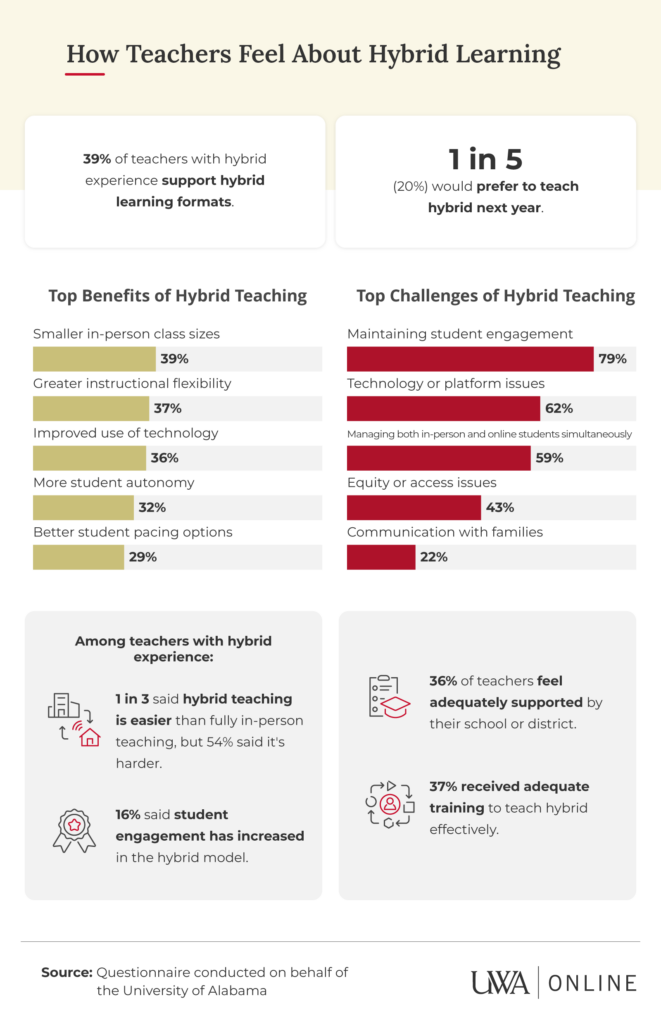
- 36% of teachers feel adequately supported by their schools, and 37% received adequate training for hybrid learning.
- One in five teachers (20%) would prefer to teach in a hybrid format next year.
Parents’ Support and Core Concerns About Hybrid Learning
- Nearly half of parents (46%) support hybrid learning, while only 33% oppose it.
- Social isolation is parents’ biggest worry with hybrid learning: “Less social interaction” (23%) and “isolates children” (18%) top the list of challenges, while only 7% cite technology issues.
- 60% of parents said math is the most difficult subject for their child in a hybrid format, compared to reading and writing (29%) or science (28%).
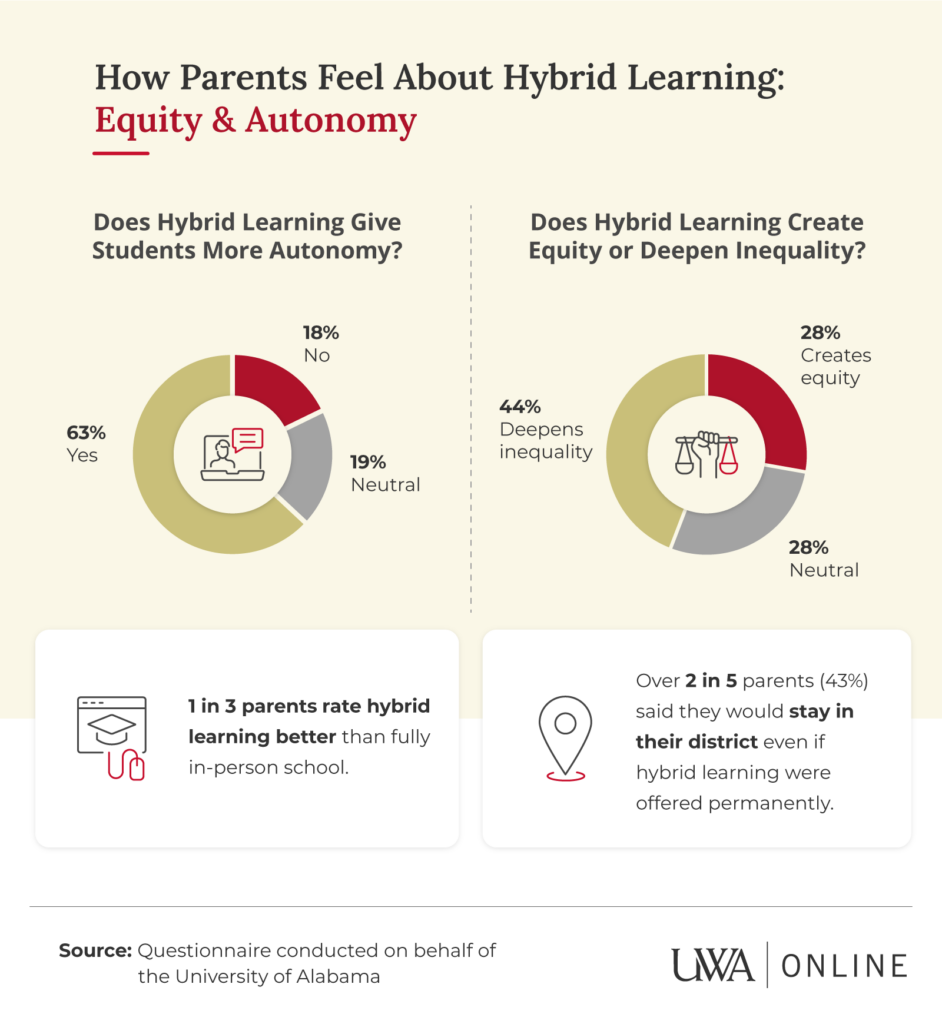
- 63% of parents agree that hybrid learning gives students more autonomy over how they learn, while 18% disagree.
- 44% of parents believe hybrid learning deepens educational inequality, compared to 28% who believe it creates more equity and 28% who think it has no effect.
Teachers’ Experiences and Insights
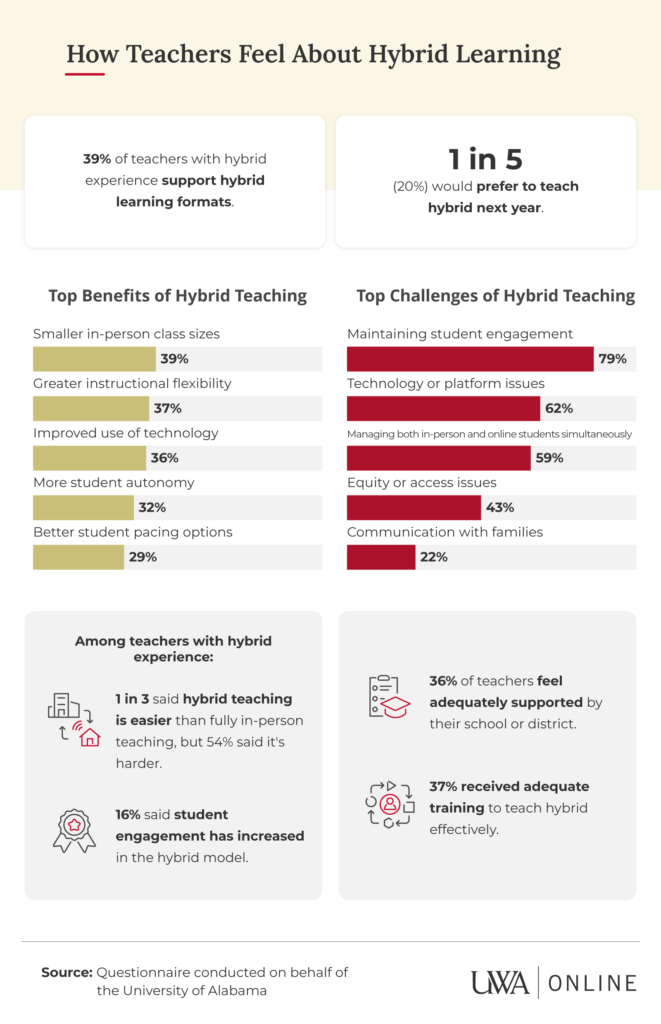
- Teachers like that hybrid learning means smaller in-person classes (39%), greater instructional flexibility (37%) and better student-pacing options (29%).
- The top challenge in hybrid teaching is maintaining student engagement (79%). It is more of a problem than technology issues (62%) or managing in-person and online students at the same time (59%).
- Teachers feel undersupported: Only 36% feel adequately supported by their school or district, and just 37% received adequate training, pointing to institutional gaps rather than teacher resistance.
- While 54% of teachers said hybrid teaching is harder than in-person, 33% actually find it easier.
What the Hybrid Debate Signals for K-12 Educators
Hybrid learning remains a meaningful part of the K-12 conversation, with parents and teachers expressing both optimism and concern. While families often value flexibility and autonomy, educators highlight a need for better institutional support and training.
For current and prospective education degree students, these findings underscore the importance of developing skills in digital instruction, student engagement and adaptable lesson design. As instructional models evolve, well-prepared teachers will play a central role in shaping effective and equitable learning environments.
Thinking about a career in education?
Learn MoreMethodology
A questionnaire was conducted on behalf of the University of West Alabama between January 29 and February 4, 2026, to understand how parents and teachers perceive hybrid learning models for K-12 students. A total of 747 parents of K-12 students and 229 K-12 classroom teachers completed the survey.
Among parent respondents, 22% currently have children participating in a hybrid learning model, 52% previously had children in a hybrid model and 26% had never participated. Among teacher respondents, 10% currently teach in a hybrid model, 59% previously taught in one and 30% had never taught hybrid.
The survey explored attitudes toward hybrid learning, perceived benefits and challenges, impacts on student engagement and academic performance, and levels of educator support and training. As with all self-reported surveys, responses reflected participants’ personal experiences and perceptions and may not represent the views of all parents and teachers nationwide.
About the University of West Alabama
The University of West Alabama offers flexible online programs designed for working adults and aspiring educators. UWA’s online Bachelor of Science in Early Childhood and Elementary Education program, which includes certification in early childhood education, prepares future teachers to support diverse learners across foundational grade levels. The program blends coursework in child development, instructional strategies and classroom management with practical field experiences.
Fair Use Statement
The information in this article may be shared for noncommercial purposes only. Any reuse must include proper attribution and a link back to the University of West Alabama.